Canada’s Instrumentation Leader Since 1946.

Canada’s Instrumentation Leader Since 1946.

 Hoskin Environmental
Sampling and monitoring instruments for air, water, weather and soil for the environmental, agricultural, mining and research markets.

 Hoskin Geotechnical
Materials and Product testing for soil, asphalt, petroleum, concrete, mining, cement, and research industries.

 Hoskin Instrumentation
Sensors, transducers and instrumentation for industry, manufacturing, research and development and factory automation.
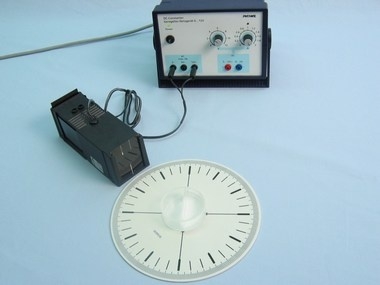
In this experiment, the students have the possibility of deepening their understanding of the law of refraction.
 Contact us for details
Principle
In this experiment, the students have the possibility of deepening their understanding of the law of refraction. By observing the refraction at the boundary between two liquids compared to the refraction at the boundary between air and a liquid, the students learn that refraction is not only a function of one medium but always of the two media forming the boundary.
The qualitative comparison of the different parts of the experiment makes the importance of boundaries between two media clear to the students. A quantitative evaluation makes it possible to work out the relationship between the different (relative) refractive indices. This calculation is carried out in a supplementary problem. It is particularly appropriate for students in the higher classes for deepening their understanding of Snell’s law of refraction.
With respect to the experimental skills required, the task is particularly demanding as very small changes in the angles must be observed – especially in the case of refraction at the boundary between water and glycerine. A careful adjustment is therefore particularly necessary in the quantitative evaluation.
Benefits
Tasks
Why is light refracted at the boundary between two liquids?
| Device name | Article no. | Quantity |
|---|---|---|
| Light box, halogen 12V/20 W | 09801-00 | 1 |
| Cuvette, double semicircular | 09810-06 | 1 |
| Optical disk | 09811-00 | 1 |
| PHYWE Power supply, 230 V,DC: 0…12 V, 2 A / AC: 6 V, 12 V, 5 A | 13506-93 | 1 |


Copyright - 2025 - Hoskin Scientific

