Canada’s Instrumentation Leader Since 1946.

Canada’s Instrumentation Leader Since 1946.

 Hoskin Environmental
Sampling and monitoring instruments for air, water, weather and soil for the environmental, agricultural, mining and research markets.

 Hoskin Geotechnical
Materials and Product testing for soil, asphalt, petroleum, concrete, mining, cement, and research industries.

 Hoskin Instrumentation
Sensors, transducers and instrumentation for industry, manufacturing, research and development and factory automation.
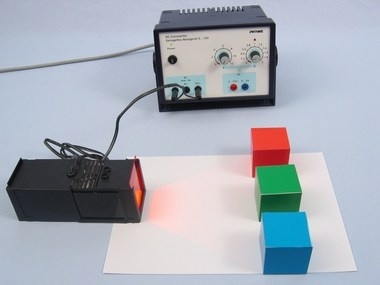
In this experiment, the students investigate how this everyday phenomenon arises. On summarizing of their observations, the students should discover that the colour of an object depends on the colour of the illuminating light.
 Contact us for details
Principle
Objects in our environment possess different colours. In addition they appear different in the light of evening sun than when the it is high in the sky.
In this experiment, the students investigate how this everyday phenomenon arises. On summarizing of their observations, the students should discover that the colour of an object depends on the colour of the illuminating light. The colour impression arises because a particular part of the spectrum is reflected from bodies and other parts absorbed. The colour of the object is produced as a secondary colour by the reflected portion.
The prior conduction of the other experiments on colour mixing is advantageous, because the students can then name the colour component of the light from the filter more easily. Thus, they are able to explain the observed phenomena. Conversely, this experiment is also appropriate as an introduction and as a motivation to consider colour mixing in more detail.
Benefits
Tasks
Why do objects have different colours? Illuminate objects with light of different colours and investigate the changes which take place.
| Device name | Article no. | Quantity |
|---|---|---|
| Colour filter set, additive (red, blue, green) | 09807-00 | 1 |
| Light box, halogen 12V/20 W | 09801-00 | 1 |
| Colour filter set, subtractive (yellow, magenta, cyan) | 09808-00 | 1 |
| PHYWE Power supply, 230 V,DC: 0…12 V, 2 A / AC: 6 V, 12 V, 5 A | 13506-93 | 1 |


Copyright - 2025 - Hoskin Scientific

